
120 min read
Practice Paper
150 practice questions across Sections A–G, with core questions marked ★ to do first.
About This Paper
This paper has questions in seven sections (A to G), with the same kinds of question as the final paper. The numbers and situations are new, so you practise the method.
How to use your hours:
- First do the core questions, marked ★. They cover every type of question. Spend about minutes per section.
- Mark each section with the answers as soon as you finish it.
- Use any time left for the other questions — start with the sections where you lost marks.
Work on paper and show every step. Stuck? Go back to the recap page for that topic.
Section A — Basic Concepts of Algebra
A1–A8: evaluate. A9–A16: simplify using the laws of indices. A17–A22: solve for . (Recap: Basic Concepts of Algebra)
A1. ★ Evaluate when .
A2. Evaluate when .
A3. Evaluate when .
A4. Evaluate when .
A5. ★ Evaluate when .
A6. Evaluate when .
A7. Evaluate when .
A8. Evaluate when .
A9. ★ Simplify .
A10. Simplify .
A11. Simplify .
A12. ★ Simplify .
A13. Simplify .
A14. Simplify .
A15. Simplify .
A16. Simplify , and write down the value of .
A17. ★ Solve , given .
A18. Solve , given .
A19. Solve , given .
A20. ★ Solve , given .
A21. Solve , given .
A22. Solve , given .
Section B — Set Operations
B1–B8 use the sports survey below. B9–B11 use the café survey (in B9). B12–B17 use the sets given in B12. (Recap: Set Operations)
A survey asked students which sports they play — Football (F), Cricket (C) and Volleyball (V).
- play Football
- play Cricket
- play Volleyball
- play Football and Cricket
- play Football and Volleyball
- play Cricket and Volleyball
- play all three sports
B1. ★ Use the survey above. Draw a Venn diagram with three circles and fill in the number of students in every region.
B2. ★ How many students play none of the three sports?
B3. ★ How many play Football only?
B4. ★ How many play Football and Cricket, but not Volleyball?
B5. ★ How many play Cricket and Volleyball, but not Football?
B6. How many play exactly one sport?
B7. How many play exactly two sports?
B8. How many play at least one sport?
B9. A café asked customers what they drank this week: Tea (T), Coffee (K) and Juice (J). had tea, coffee and juice; had tea and coffee, tea and juice, coffee and juice, and had all three. How many customers had none of the three drinks?
B10. Using the café survey, how many had coffee only?
B11. Using the café survey, how many had tea and juice, but not coffee?
B12. ★ For questions use the sets , , , . Is ? Explain.
B13. ★ Which of these are true? (a) (b) (c) (d)
B14. ★ Write down and .
B15. Write down .
B16. ★ Write down , and .
B17. Find and .
B18. ★ , and . Find .
B19. , and . Find .
B20. , and . Find .
B21. , and . Find . Is this data possible?
B22. , , . Find , , , and .
Section C — Matrices
Show the order of each matrix and every multiplication step. (Recap: Matrices)
C1. ★ Find and , where and .
C2. Find and , where and .
C3. Find and , where and .
C4. ★ Find and , where and .
C5. State the order of and of .
C6. ★ Find , where .
C7. Find , where .
C8. Find , where .
C9. Find , where and .
C10. ★ Find and , where and .
C11. ★ Find and , where and .
C12. Find and , where and .
C13. Find , where and .
C14. A is a matrix and B is a matrix. Is possible? What is its order? Is possible?
C15. ★ Find the determinant of .
C16. Find the determinant of .
C17. Find the determinant of .
C18. ★ Find the determinant of .
C19. Find the determinant of .
C20. Find the determinant of .
C21. Find if .
C22. What is the identity matrix , and what is for any matrix ?
Section D — Trigonometry
Use and . Give lengths to decimal places where needed. D1–D3 use Figure . (Recap: Trigonometry)
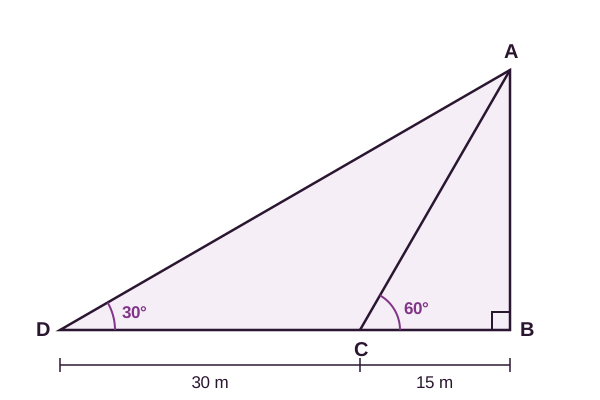
D1. ★ Use Figure . Find the height AB.
D2. ★ Use Figure . Find AD.
D3. Use Figure . Find AC.
D4. In another right-angled triangle ABD (right angle at B), point C lies on DB. , and . Find AB, DC and AD. (, )
D5. ★ Nimal stands from a flagpole. The angle of elevation of the top is °, and his eye level is above the ground. How tall is the flagpole?
D6. ★ From away, the angle of elevation of the top of a tower is °. Eye level is . Find the height of the tower. ()
D7. A student from a building sees the top at an angle of elevation of °. Eye level is . Find the height of the building. ()
D8. From the top of a cliff, the angle of depression of a boat is °. How far is the boat from the foot of the cliff? ()
D9. A kite string is long and makes an angle of ° with the ground. How high is the kite? ()
D10. A ladder makes an angle of ° with the ground. Its foot is from the wall. How long is the ladder?
D11. ★ A right-angled triangle PQR has the right angle at Q, cm and cm. Find PR.
D12. A right-angled triangle PQR has the right angle at Q, cm and cm. Find PR.
D13. In triangle XYZ, the right angle is at Y. cm and cm. Find YZ.
D14. ★ In triangle XYZ, the right angle is at Y. cm and cm. Find YZ.
D15. ★ A ladder long leans against a wall. Its foot is from the wall. How high up the wall does it reach?
D16. A ladder reaches up a building. Its foot is from the building. Find the height it reaches.
D17. A ladder stands with its foot from a wall. How high does it reach? Give your answer to decimal places.
D18. A rectangle is cm long and cm wide. Find the length of its diagonal.
D19. Is a triangle with sides cm, cm and cm right-angled? Show how you know.
D20. Write down the exact values of , , and .
D21. A right-angled triangle has an angle θ. The side opposite θ is cm and the hypotenuse is cm. Find the adjacent side, then , and .
D22. A ramp rises over a horizontal distance of . What angle does it make with the ground?
Section E — Descriptive Statistics
Show the sorted list or a frequency table in every answer. (Recap: Descriptive Statistics)
E1. ★ students took a quiz. Their scores out of were: , , , , , , , , , , . Find the mean, median, mode and range.
E2. The daily rainfall (mm) over days was: , , , , , , , , . Find the mean, median, mode and range.
E3. workers' ages were: , , , , , , , , , . Find the mean, median, mode and range.
E4. students' shoe sizes were: , , , , , , . Find the mean, median, mode and range.
E5. parcels weighed (kg): , , , . Find the mean, median, mode and range.
E6. The mean of numbers is . Four of them are , , and . Find the fifth number.
E7. ★ A survey of families recorded the number of children in each family:
, , , , , , , , , , , , , , , , , , , , , , , , , , , , ,
Make a frequency distribution table.
E8. ★ Using the family survey, find the mean number of children.
E9. ★ Using the family survey, find the median.
E10. ★ Using the family survey, find the mode.
E11. Using the family survey, find the range, and the percentage of families with more than children.
E12. ★ Draw a bar chart of the family survey.
E13. This frequency table shows how many books students read in a month:
| Books read | ||||||
|---|---|---|---|---|---|---|
| Students |
How many students were surveyed, and what is the mode?
E14. Using the books table, find the mean and median.
E15. The marks of students are , , , , , . A seventh student scores . Which of the mean, median and mode changes the most?
E16. Which average is best for the incomes , , , and (LKR)? Explain.
E17. Add to every value in a data set. What happens to the mean and to the range?
E18. The mean number of cars per household is . Can this be right if no family owns cars? Explain.
E19. Why should a bar chart of discrete data (such as the number of children) have gaps between the bars?
E20. Two classes took the same test. Class X: mean , range . Class Y: mean , range . Compare the classes.
Section F — Probability
Give each probability as a fraction in its simplest form (and as a decimal where helpful). (Recap: Probability)
F1. ★ A letter is picked at random from the word PEPPER. Which letter is most likely to be picked?
- a) E
- b) P
- c) R
- d) None of the above
F2. A letter is picked at random from SUCCESS. Which letter is most likely?
- a) U
- b) C
- c) S
- d) E
F3. A letter is picked at random from CHEESE. Find .
F4. A letter is picked at random from EXAMINATION. Find the probability that it is a vowel.
F5. ★ A number is chosen at random from: , , , , , , , . What is the probability that it is even?
- a)
- b)
- c)
- d) None of the above
F6. A number is chosen at random from: , , , , , , , , , . Find the probability that it is even.
F7. A whole number from to is chosen at random. Find the probability that it is a multiple of .
F8. A whole number from to is chosen at random. Find the probability that it is prime.
F9. ★ One card is drawn at random from a standard pack of cards. Find the probability that it is a king.
F10. One card is drawn at random from a standard pack of cards. Find the probability that it is a red card.
F11. ★ One card is drawn at random from a standard pack of cards. Find the probability that it is a picture card (J, Q or K).
F12. One card is drawn at random from a standard pack of cards. Find the probability that it is a heart.
F13. One card is drawn at random from a standard pack of cards. Find the probability that it is a red ace.
F14. One card is drawn at random from a standard pack of cards. Find the probability that it is not a spade.
F15. One card is drawn at random from a standard pack of cards. Find the probability that it is an ace or a king.
F16. ★ A bag holds counters in four colours. A counter is taken at random, its colour noted, and it is put back. This is done times: red , blue , green , yellow . Find the (experimental) probability of drawing a red counter.
F17. Using the counter experiment, find the probability of drawing a green counter.
F18. ★ Using the counter experiment, find the probability of drawing a blue or a yellow counter.
F19. ★ Using the counter experiment, find the probability of not drawing a yellow counter.
F20. Using the counter experiment, estimate how many of the counters are red.
F21. A fair six-sided die is rolled. Find and .
F22. Which of these cannot be a probability? , , , . Explain.
Section G — Accuracy and Precision
G1–G8 use Figure . (Recap: Accuracy and Precision)
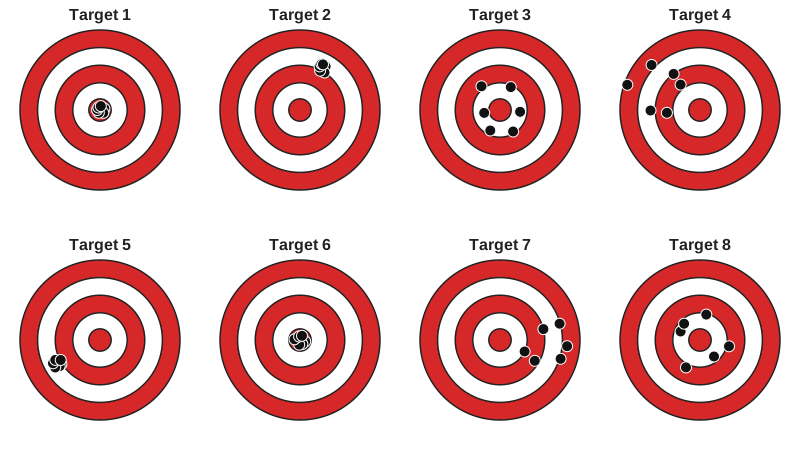
G1. ★ Which statement describes Target in Figure ?
- a) High accuracy and high precision
- b) Low accuracy and low precision
- c) High accuracy and low precision
- d) Low accuracy and high precision
G2. ★ Which statement describes Target in Figure ?
- a) High accuracy and high precision
- b) Low accuracy and low precision
- c) High accuracy and low precision
- d) Low accuracy and high precision
G3. ★ Which statement describes Target in Figure ?
- a) High accuracy and high precision
- b) Low accuracy and low precision
- c) High accuracy and low precision
- d) Low accuracy and high precision
G4. ★ Which statement describes Target in Figure ?
- a) High accuracy and high precision
- b) Low accuracy and low precision
- c) High accuracy and low precision
- d) Low accuracy and high precision
G5. Which statement describes Target in Figure ?
- a) High accuracy and high precision
- b) Low accuracy and low precision
- c) High accuracy and low precision
- d) Low accuracy and high precision
G6. Which statement describes Target in Figure ?
- a) High accuracy and high precision
- b) Low accuracy and low precision
- c) High accuracy and low precision
- d) Low accuracy and high precision
G7. Which statement describes Target in Figure ?
- a) High accuracy and high precision
- b) Low accuracy and low precision
- c) High accuracy and low precision
- d) Low accuracy and high precision
G8. Which statement describes Target in Figure ?
- a) High accuracy and high precision
- b) Low accuracy and low precision
- c) High accuracy and low precision
- d) Low accuracy and high precision
G9. Which targets in Figure show both high accuracy and high precision?
G10. Which targets show shots clustered together but far from the centre? Name this combination.
G11. Which targets in Figure show low accuracy and low precision?
G12. Define accuracy and precision in one sentence each.
G13. ★ A kg mass is weighed three times: kg, kg, kg. Describe the scale.
G14. A thermometer measures water at exactly °C four times: , , , °C. Describe it.
G15. A stopwatch records a s event as , , , s. Describe it.
G16. A ruler with a worn end gives , , cm for a cm line. What kind of error is this, and how does it affect accuracy and precision?
G17. What kind of error causes readings to be scattered (low precision)?
G18. Can a set of results be precise but not accurate? Give an everyday example.
G19. How can you improve precision, and how can you improve accuracy?
G20. In a darts game, all of Amali's darts land in a tight group in the outer ring, far from the bullseye. Which describes her throws?
- a) High accuracy and low precision
- b) Low accuracy and high precision
- c) High accuracy and high precision
- d) Low accuracy and low precision
More lessons in Recap and Practice · Next: Practice Paper: Answers · Previous: Recap G — Accuracy and Precision