
22 min read
Recap B — Set Operations
Set symbols, the empty set, subsets, the two-set formula and Venn diagrams — explained simply with 14 worked examples.
The Big Idea
A set is a collection of things, written inside curly brackets: . Each thing is an element. We write (" is an element of A") and .
Think of a set as a box. The elements are the things inside the box. Each element is listed once, and the order does not matter.
1. The Symbols
| Symbol | Name | In simple words |
|---|---|---|
| union | everything in A or B (or both), no repeats | |
| intersection | only what is in both | |
| difference | in A but not in B | |
| complement | everything in the universal set U that is not in A | |
| number of elements | how many things are in A | |
| subset | every element of A is also in B | |
| or | empty set | a set with nothing in it |
Example 1 — union and intersection
Question: and . Find and .
Answer:
- : everything from both, each once →
- : only what is in both →
Example 2 — difference
Question: Using the same sets, find and .
Answer:
- : start with A, remove anything in B →
- : start with B, remove anything in A →
The order matters: .
Example 3 — complement
Question: and . Find and .
Answer:
is everything in U that is not in A: , so .
2. The Empty Set and Subsets
Example 1 — is { } the same as {∅}?
Question: Is ?
Answer:
No. has elements. has element (the empty set). Sets with different numbers of elements cannot be equal.
Example 2 — subsets
Question: . Which are true? (a) (b) (c)
Answer:
- (a) True — and are both in A.
- (b) True — the empty set is a subset of every set.
- (c) False — is not in A, so not every element is in A.
Example 3 — a set of sets (the tricky one)
Question: and . Is ? Is ? Find .
Answer:
- G is a box of numbers. H is a box of small boxes.
- : true — the number is in G.
- : false — the number is not in H. H contains the box , so instead is true.
- — numbers and boxes are never the same thing.
Example 4 — union and difference with sets of sets
Question: Using G and H above, find , , and .
Answer:
- (nothing in H is in G)
- — the empty set counts as one element.
3. The Two-Set Formula
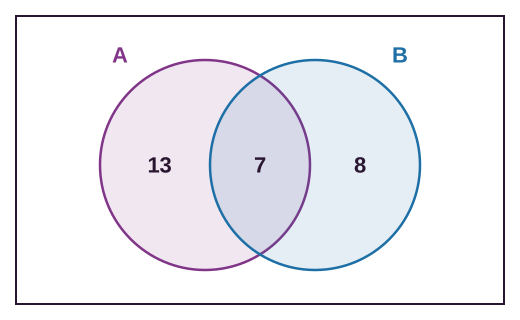
Example 1 — find the intersection
Question: , , . Find .
Answer:
Sense check: is not more than the smaller set () ✓
Example 2 — find the union
Question: , , . Find .
Answer:
Example 3 — find a missing set
Question: , , . Find .
Answer:
, so .
Example 4 — impossible data
Question: , , . Find .
Answer:
Formula: . But is part of A, so it can have at most elements — and cannot be smaller than . The data is impossible. Always check that your answer makes sense, and say so if it does not.
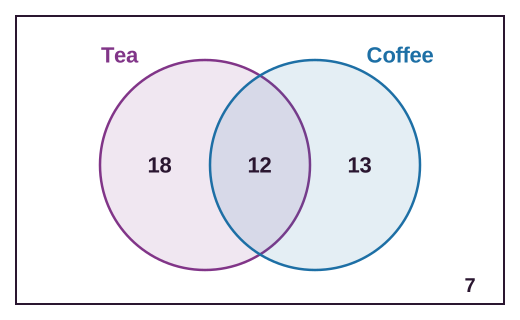
Example 1 — a two-circle survey
Question: people were asked about drinks: drink tea, drink coffee and drink both. How many drink tea only, coffee only, and neither?
Answer:
Fill the Venn diagram from the middle outwards:
- Both:
- Tea only:
- Coffee only:
- Neither:
4. Three-Circle Venn Diagrams
A three-circle Venn diagram has regions: the centre (all three), three "two only" regions, three "one only" regions, and the outside (none).
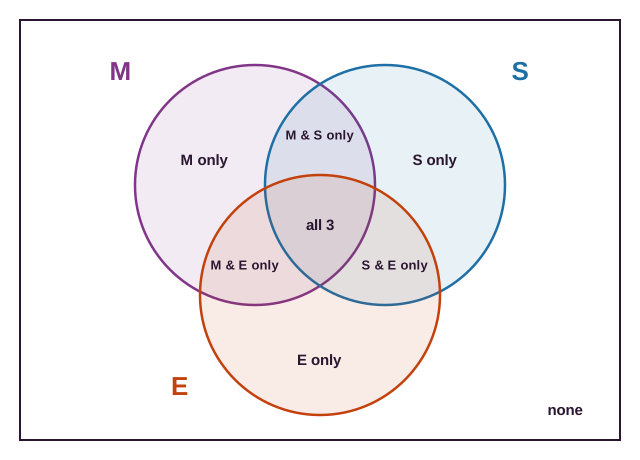
Example 1 — a full three-set survey
Question: students were asked about three subjects: Maths (M) , Science (S) , English (E) ; M and S ; M and E ; S and E ; all three . Fill in the Venn diagram.
Answer:
| Step | Region | Working | Answer |
|---|---|---|---|
| All three | given | ||
| M and S only | |||
| M and E only | |||
| S and E only | |||
| M only | |||
| S only | |||
| E only | |||
| None | − () |
Check: ✓
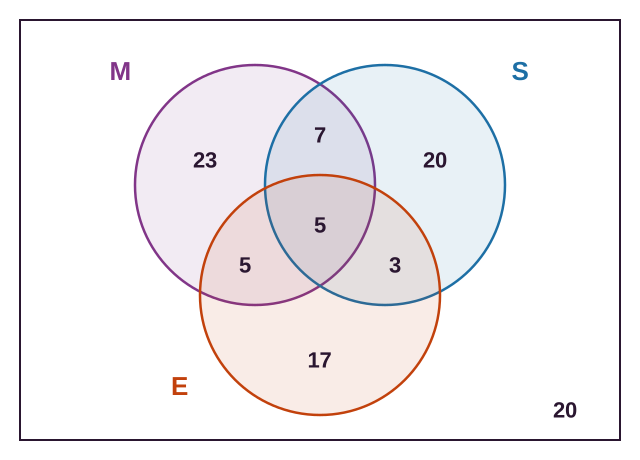
Example 1 — reading the diagram
Question: Using the completed diagram, how many students take (a) Maths only, (b) Maths and Science but not English, (c) none, (d) exactly one subject, (e) at least two subjects?
Answer:
- (a) Maths only:
- (b) M and S only:
- (c) None:
- (d) Exactly one: =
- (e) At least two: =
Your turn — try these on paper, then check the answers below.
. , . Find , and .
. Is true?
. , , . Find .
. In the subject survey, how many students take English and Science but not Maths?
Example 1 — Answers to Your Turn
. ; ;
. True — the empty set is a subset of every set.
.
. S and E only =
Next: Recap C — Matrices
More lessons in Recap and Practice · Next: Recap C — Matrices · Previous: Recap A — Basic Concepts of Algebra