
24 min read
The Three Ratios
Sine, cosine, and tangent connect an angle in a right-angled triangle to the ratio of two of its sides.
Naming the Sides
Relative to a chosen angle (not the right angle) in a right-angled triangle, the three sides get special names:
- Hypotenuse: the longest side, opposite the right angle (always the same, whichever angle you choose).
- Opposite: the side directly across from the chosen angle.
- Adjacent: the remaining side, next to the chosen angle (but not the hypotenuse).
Opposite and adjacent swap if you switch which acute angle you are using. The diagrams below show the same idea in four orientations.
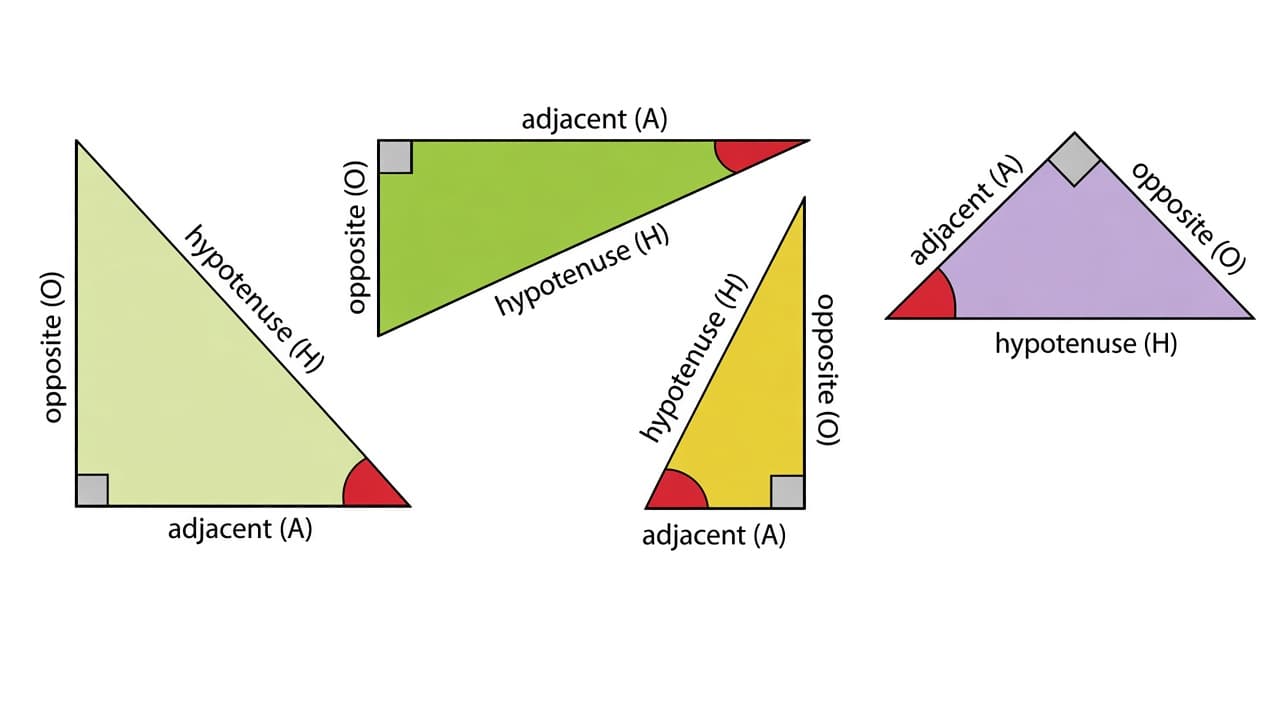
Opposite, adjacent, hypotenuse
The hypotenuse is always opposite the right angle. Opposite and adjacent depend on which acute angle is θ.
Tap each orientation. Watch how opposite and adjacent move with θ, while the hypotenuse stays across from the right angle.
The Three Ratios
| The three ratios | |
|---|---|
| Exact values for common angles | |||||
|---|---|---|---|---|---|
Right triangle — labelled for θ
θ ≈ 36.9° · sin θ ≈ 0.600 · cos θ ≈ 0.800 · tan θ ≈ 0.750
Example 1 — working out a ratio
A right-angled triangle has Opposite = , Hypotenuse = (relative to angle θ). Find .
Answer:
Example 2 — using tan
A right-angled triangle has Opposite = , Adjacent = (relative to angle θ). Find .
Answer:
Practice
More lessons in Trigonometry · Next: Finding Missing Sides · Previous: Pythagoras' Theorem