
30 min read
Angles of Elevation and Depression
Classic word problems — towers, cliffs, lighthouses, kites, ladders — each with a clear diagram and tan or sin.
What the Angles Mean
These angles show up everywhere in textbooks: looking up at a tower, down from a lighthouse to a boat, flying a kite, or leaning a ladder on a wall.
Both are measured from a horizontal line through the observer's eye — never from a wall or the sloping line of sight alone.
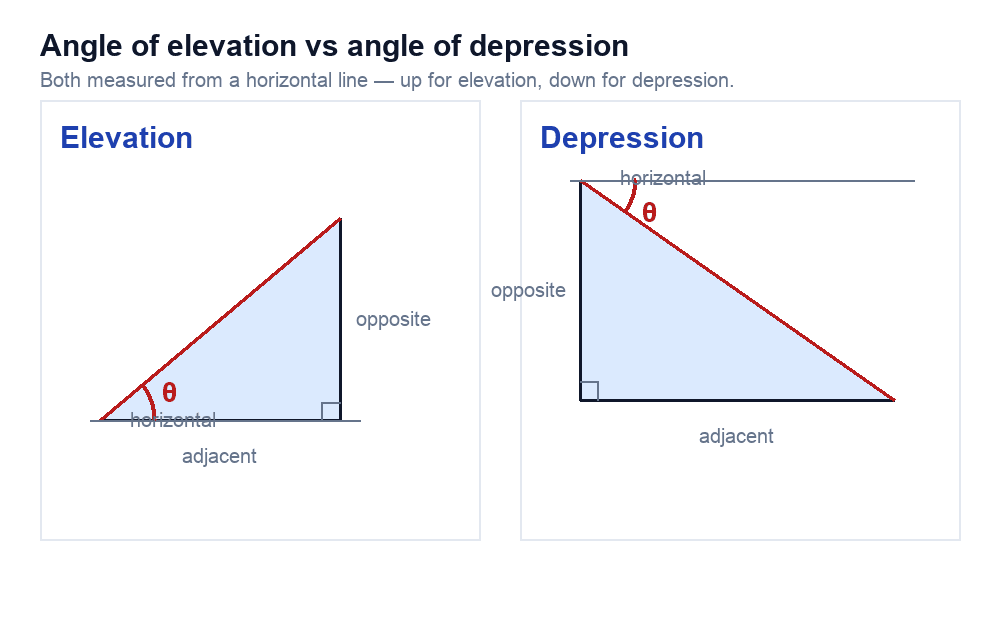
In almost every problem you get a right-angled triangle where:
- the vertical side is opposite the angle
- the horizontal side is adjacent to the angle
So you usually use tan:
When the sloping length is given (string, ladder), use sin or cos instead.
Elevation — Looking Up
Start with height and distance problems. Draw the triangle, mark θ at the observer, then use tan.
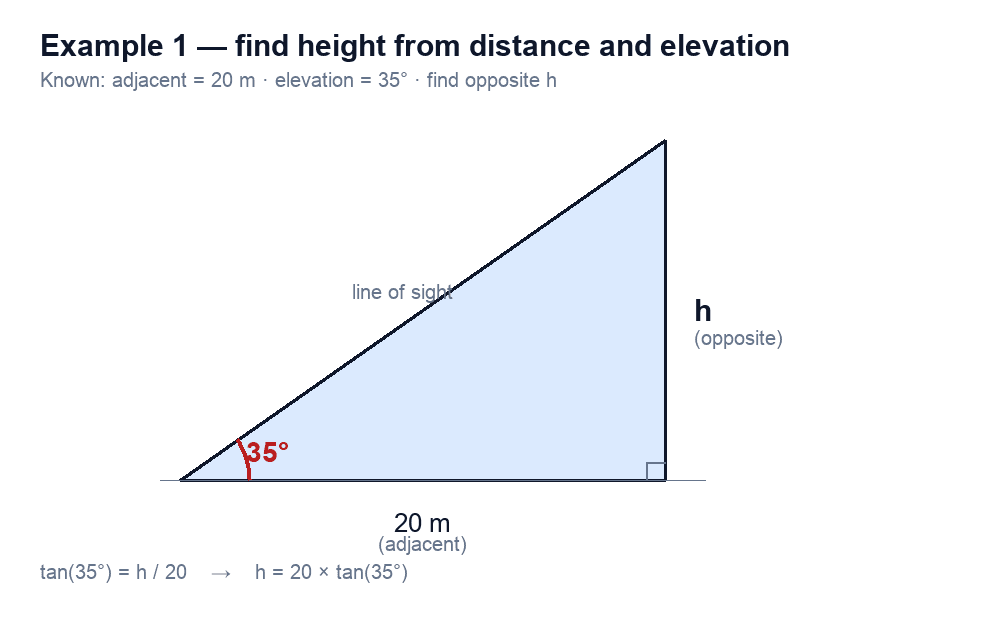
Example 1 — height of a tower
A person stands from the base of a tower. The angle of elevation to the top is °. Find the height of the tower.
Step . Adjacent = , opposite = height, θ = °.
Step .
Step . , so height .
Answer: ≈
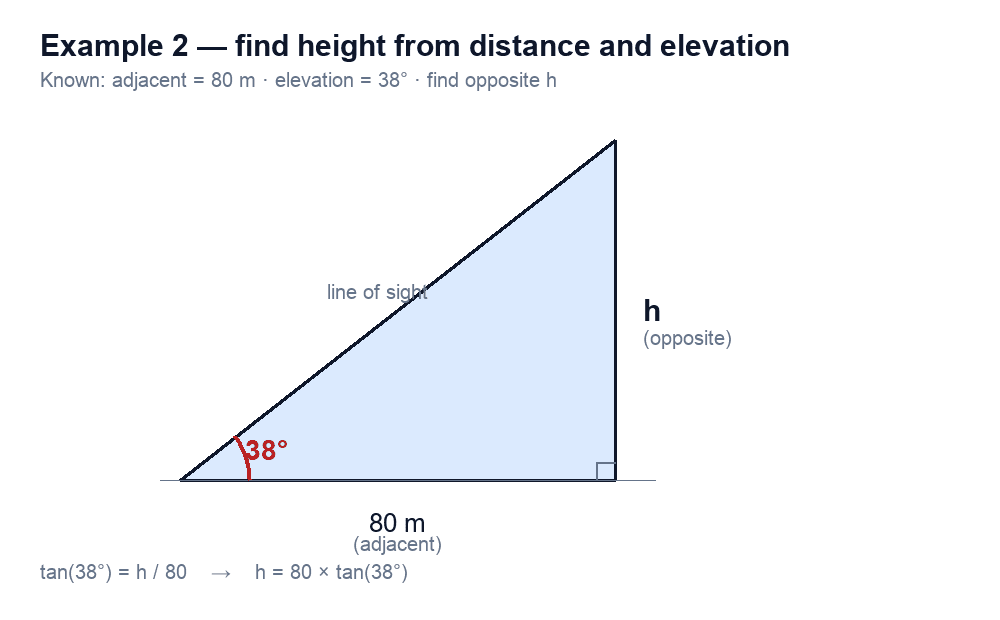
Example 1 — height of a cliff
From a point from the base of a cliff, the angle of elevation to the top is °. How high is the cliff?
Step .
Step . , so .
Answer: ≈ (about )
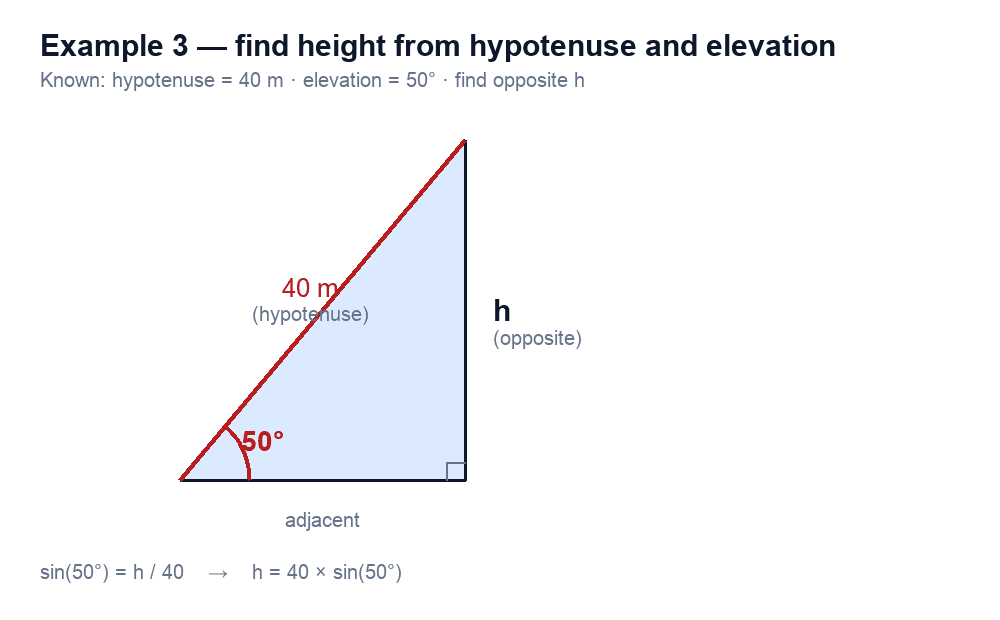
Example 1 — kite on a string
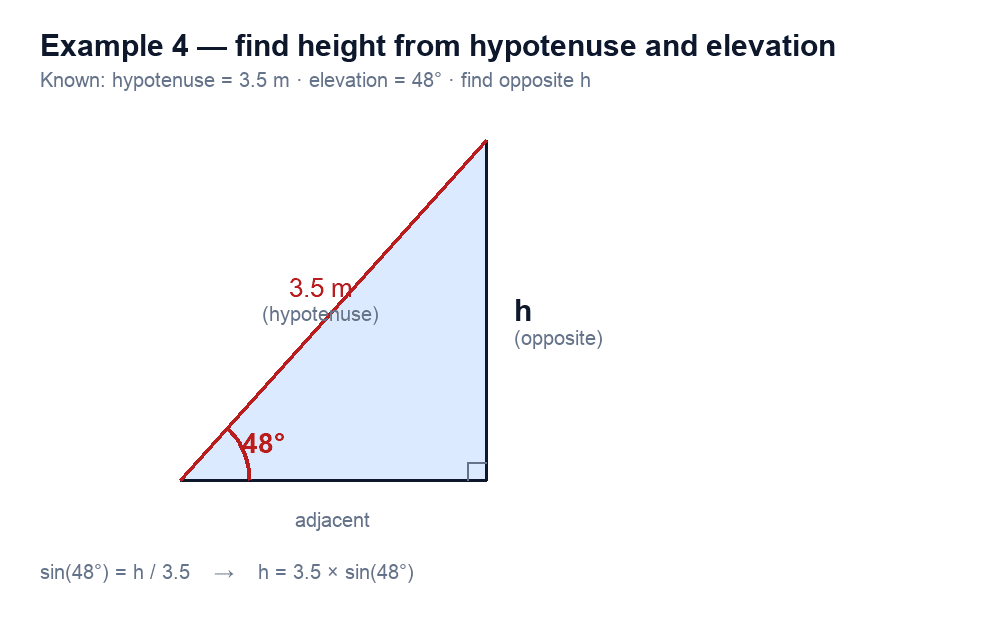
A kite string is long and makes a ° angle of elevation with the ground. How high is the kite?
Step . Hypotenuse = , opposite = height, θ = °.
Step .
Step . , so .
Answer: ≈
Example 1 — ladder against a wall
A ladder leans against a wall and makes a ° angle with the ground. How high up the wall does it reach?
Step . Hypotenuse = , opposite = height on wall, θ = °.
Step .
Step . , so .
Answer: ≈
Angle of elevation
a ≈ 35.75 m · total = a + 1.7 ≈ 37.45 m
Depression — Looking Down
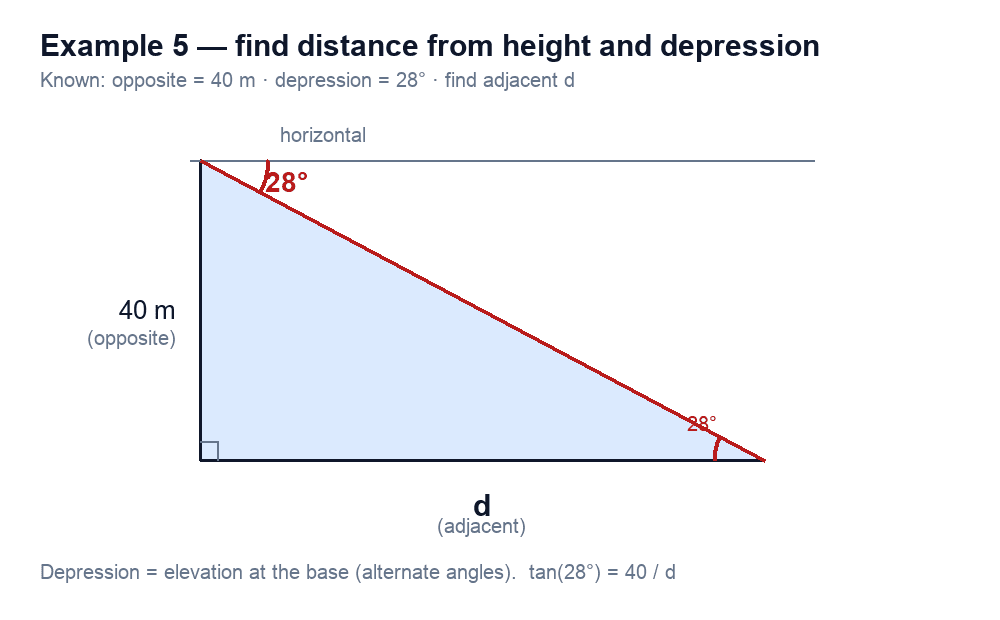
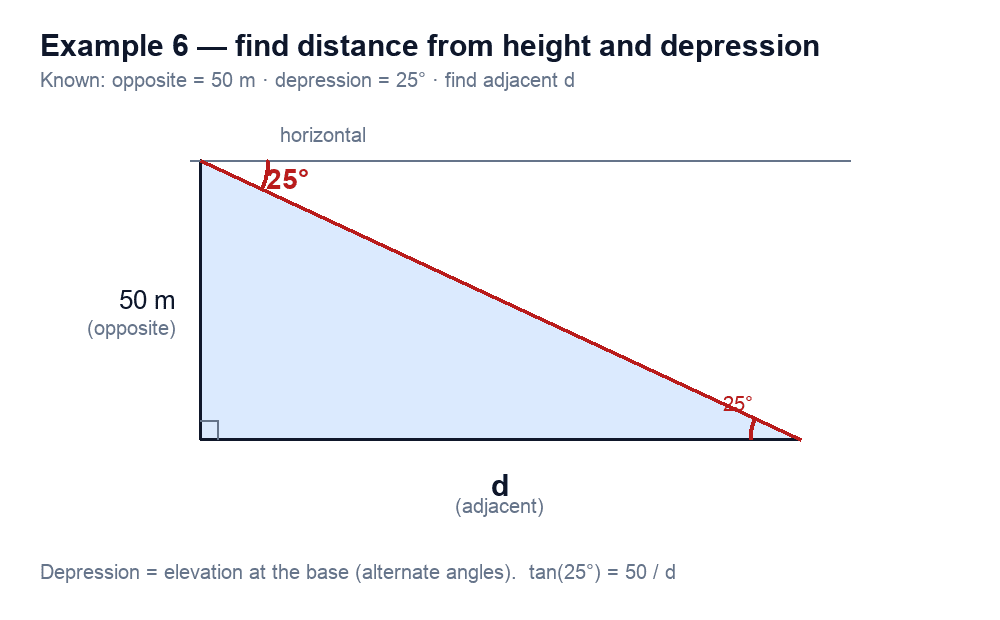
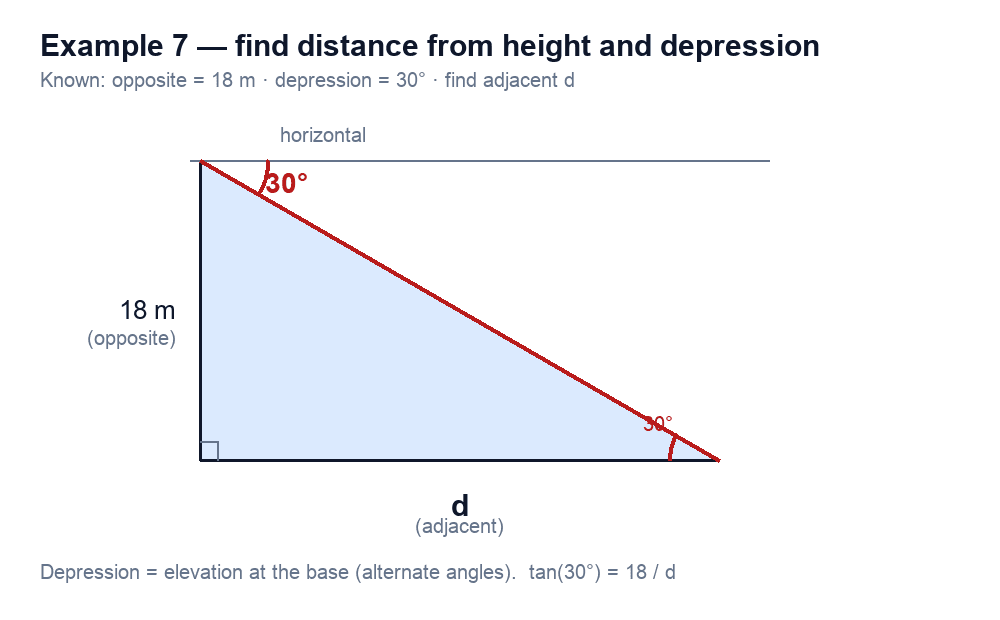
From a high place, draw the horizontal at eye level, then the line of sight down. Depression from the top equals elevation from the object (alternate angles with parallel horizontals).
Example 1 — boat from a lighthouse
From the top of a lighthouse, the angle of depression to a boat is °. How far is the boat from the base of the lighthouse?
Step . Depression ° = elevation ° from the boat.
Step .
Step . , so .
Answer: ≈
Example 1 — boat from a cliff
From the top of a cliff, the angle of depression to a boat is °. How far is the boat from the base of the cliff?
Step .
Step . , so .
Answer: ≈
Example 1 — buoy from a bridge
From a bridge above a river, the angle of depression to a buoy is °. How far is the buoy from the point on the water directly below the observer? (Use .)
Step .
Step .
Answer: ≈ (exact: )
Angle of depression
Adjacent d ≈ 75.23 m
When Eye Height Matters
The triangle starts at eye level, not at the ground. If the question asks for the full height of the object, add eye height after you find the height above the eyes.
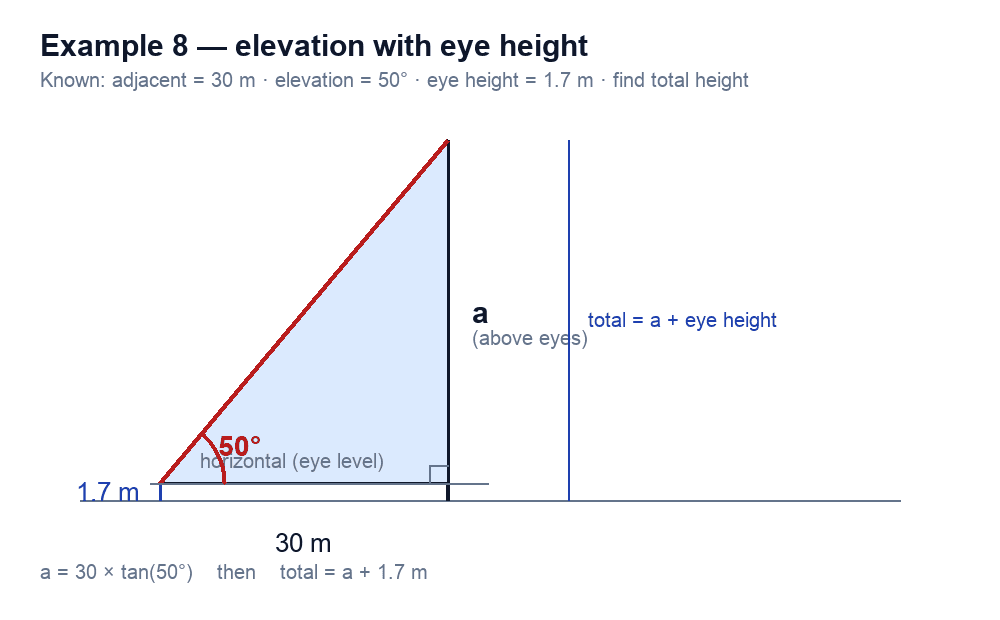
Example 1 — flagpole with eye height
From away, the angle of elevation to a flagpole top is °. Eyes are above the ground. How tall is the flagpole? ()
Step — height above eyes only.
Step — add eye height. Total
Answer: ≈
Watch Outs
Practice
Practice
Swipe or use the arrows to move between questions.
1 / 3
More lessons in Trigonometry · Next: Trigonometry Foundations Worksheet · Previous: Finding Missing Angles