
22 min read
Accuracy vs Precision
Accuracy is closeness to the true value. Precision is how tightly repeated results cluster — they are not the same idea.
G1 — What Accuracy and Precision Mean
Two words that sound similar, but ask different questions about a set of results:
- Accuracy = how close a result (or the average of several results) is to the true / target value.
- Precision = how close repeated results are to each other, whether or not they are near the true value.
Key idea: accuracy is about being right; precision is about being consistent. You can have one without the other.
G2 — The Four Combinations on a Target
Think of each measurement as a shot on a target. The bullseye is the true value. Looking at a cluster of shots, you can name both accuracy and precision.
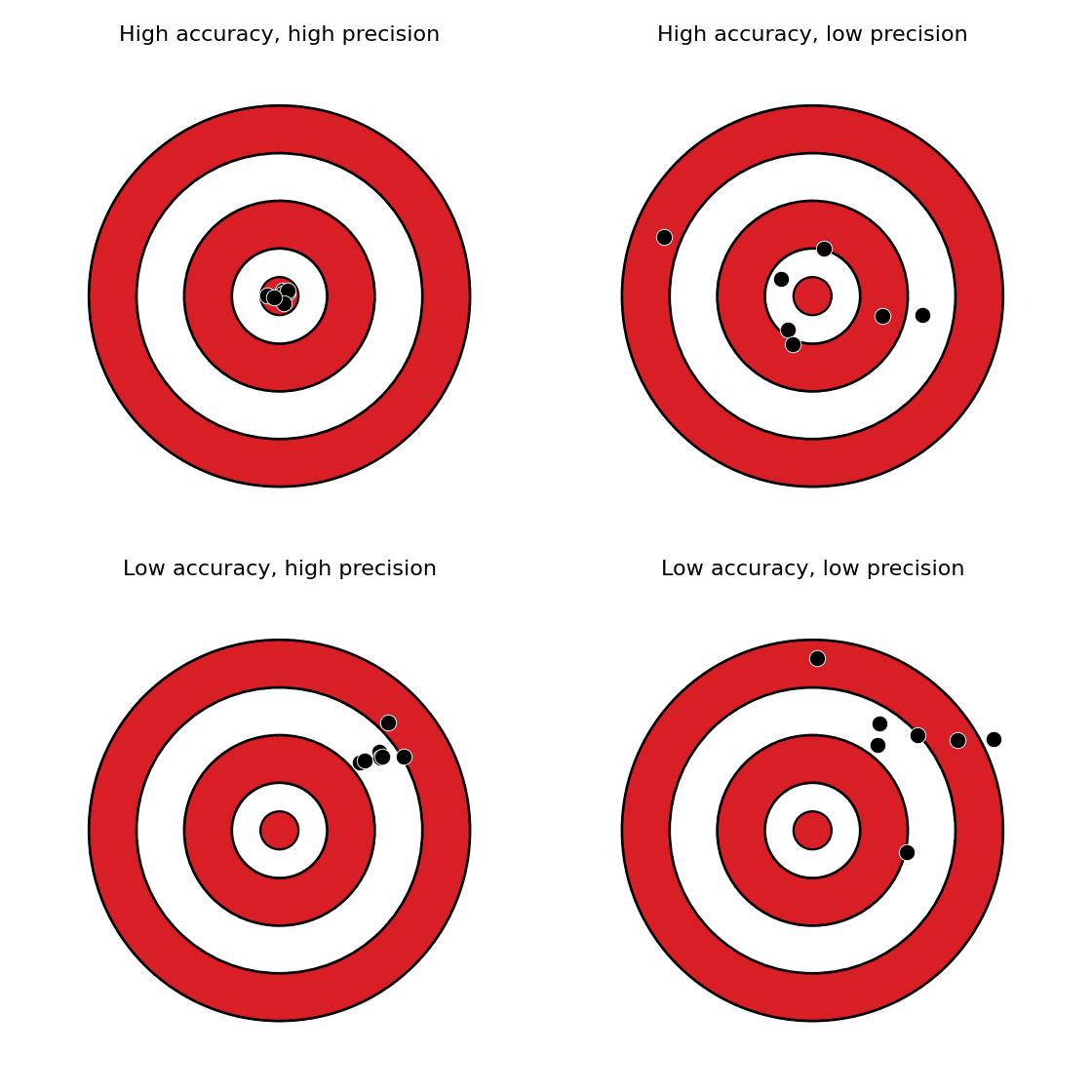
Under the four panels:
- High accuracy + high precision — tight cluster right on the bullseye.
- High accuracy + low precision — shots scattered, but centred roughly on the bullseye on average.
- Low accuracy + high precision — tight cluster off to one side.
- Low accuracy + low precision — scattered widely and off-centre.
Example 1 — Worked example — reading panel 3
Look at Low accuracy, high precision (bottom-left panel):
- The shots are close together → high precision.
- The whole cluster sits away from the centre → low accuracy.
So this panel is high precision, low accuracy — consistent, but systematically wrong (like a scale that is always kg too heavy).
Practice. Classify each practice target below as one of the four combinations.
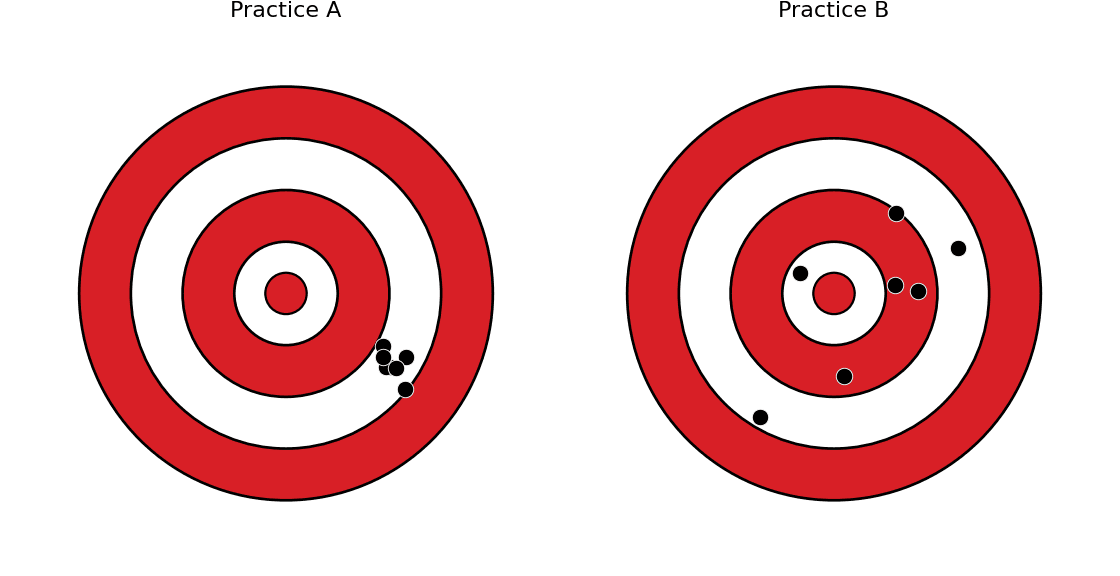
Practice A — answer: tight cluster away from the bullseye → low accuracy, high precision.
Practice B — answer: shots scattered but roughly around the centre → high accuracy, low precision.
Practice
More lessons in Numerical Precision, Accuracy and Errors · Next: Accuracy & Precision Worksheet · Previous: Relative and Percentage Error